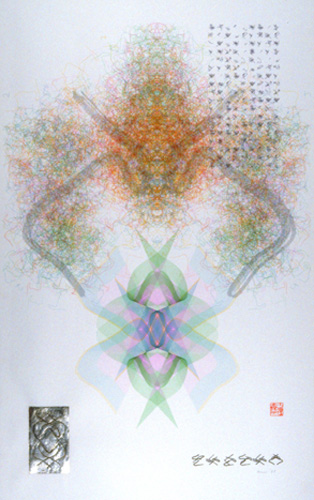
|
My paper for the 1993 Ars
Electronica Symposium Notes on Epigenetic Art: the Ezekiel Series, is quoted from Genetische
Kunst - Kunstliches Leben (Genetic Art - Artificial Life), Edited by
Karl Gerbel and Peter Weibel, (ISBN 3-901196-072, Vienna, 1993), pp
334-337. These notes revisit my original Paper on
Epigenetic Painting: Software as Genotype
(First ISEA-1988, Utrecht). Ars Electronica invited these notes
for publication along with several
selected works for the Genetic Art - Artificial Life exhibition held at
Linz in 1993.
English
Version below. For German version , see: German Version
NOTES ON EPIGENETIC ART: The Ezekiel
Series
ROMAN VEROSTKO, April 1993
Intentions. For over 30 years, as an artist,
I have always tried to create well crafted works with icon-like
qualities pointing in some evocative way to hidden reality. As early as
I can remember I was always awestruck when I took time to really look at
something and think about it as "being" and then contemplate
whether the opposite was possible - "not being". "What
would it be like", I wondered, "if there were no me - no cloud
- no earth? Early on
I learned to wonder about the "marvelous" event of things
existing just "the way they are". Within commonplace phenomena
I learned to see a "hidden" marvelous world filled with
mystery. My approach to art
grew from this marveling, always holding a reverence for the materials
of earth and a sense of wonder about most things. Eventually this came
to include circuit boards, computer languages, and the forms one could
explore with simple algorithms.
In this essay the terms "code",
"software" and "instructions" may be used
interchangeably. In general we are referring to coded procedures and
algorithms which may be integrated in a program of instructions for a
computer.
For the past decade I have been writing code and
marveling at its power as a procedure for investigating form with a
computer. Coded electronic
procedures provide artists with a radically new and powerful tool for
investigating a marvelous world of unseen form. Those who integrate
their art with coded procedures are on the threshold of a new frontier.
To tap this frontier as an artist there have been two great hurdles. One
has been the task of translating form-generating ideas into a practical
working code. The other has been the search for appropriate materials
and methods for achieving tangible archival quality work.
The code as a form-generator is only half of the
struggle. To succeed as "art" the form must be successfully
engendered in something tangible - something one can see, touch, feel or
hear. Some years ago an artist friend, standing by an elm tree, asked
"What gives this tree such a powerful presence?" And he
answered, noting that "you can touch it - feel its surface - its
'being here'"! Because aesthetic experience involves the senses one cannot
separate "art" from its material embodiment. In my current
work the form necessarily includes the paper, surface, texture, color,
and manner of presentation -
the total experience. The nature and quality of materials have been
carefully chosen and transformed in the process. For me, the finished
work should have an aura that invites the casual viewer to pause for a
moment, sensing that the work, as a human endeavor, goes beyond material
concerns.
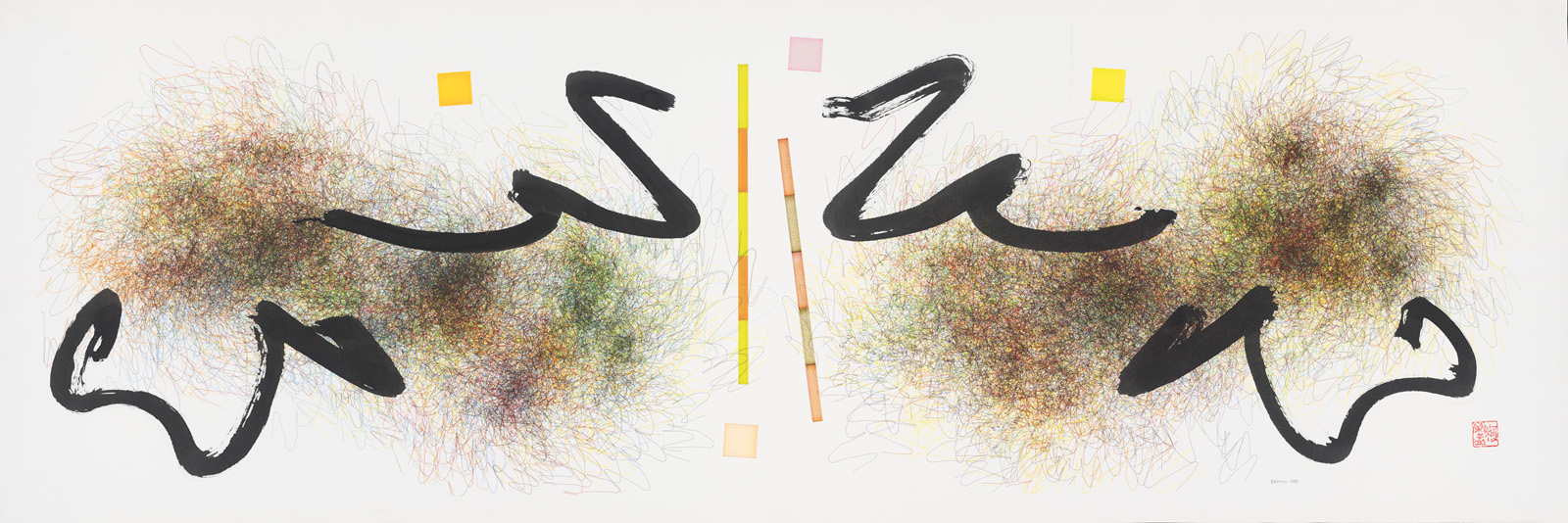
Dragon Mountain I, 1989
(91 cm X 183 cm)
algorithmic drawing plotted with with ink pens and brush. Victoria & Albert Museum, London.
Studio Workers,
Robotnics . Many people who visit my studio are surprised
when they see engineering plotters cabled to two computer work stations
- one for research and development - the other for creating art.
When a plotter is working, visitors often stand with eyes glued
on the drawing arm which, with a "seeming intelligence", draws
precisely, surprisingly, and without hesitation - executing literally
thousands of lines - changing colors - first here and then there. These
plotters exude an uncanny presence!
They have become members of the studio family - there's
Brunelleschi, a nine year old 14 pen plotter, the first one I ever used
- then another one named Alberti who executed all the frontispieces for
a limited edition of George Boole's "Derivation of the Laws"
(1989-90). Our latest member of the family, Botticelli, has a 36 inch
bed and has been executing the recent Ezekiel Series.
These workers,
robotniks , tirelessly execute instructions fed to them
from computers. The computers interpret the code for them. The code is
essentially a set of detailed instructions for making the work, i.e.,
what steps to take to make a color decision or how to determine control
points. This procedure for
making art, which I have called "epigenetic" is employed, to
some degree, by a number of artists working today.
Epigenetic Art .
The term epigenesis , borrowed from biology, refers to the
process whereby a mature plant or phenotype grows from a seed or
genotype. By analogy, in my studio, the art work (phenotype)
"grows" from the software (genotype). Although the sofware
contains the essential "form generating" information, it
requires an appropriate "environment" and
"nurturing" if it is to generate a mature work of art.
This process of actually "growing" the work in some
tangible form is, by analogy, "epigenetic". The mature art
form, likened to phenotype, can only be "grown" with tangible
materials - paper and inks - and then only with an appropriate set-up of
computer and plotter which constitute, as it were, a nurturing
environment. The convergence of all these elements is required for
"growing" the art work, a process analagous to biological
epigenesis.
A Personal Expert System . The
software, with a computer and a plotter, constitutes a "personal
expert system". The system is capable of generating visual forms of
interest to me as an artist - forms whose origins the artist can both
reveal and conceal with recursive improvisations. The choice of
materials and the evolution of the software grew side by side over a
period of ten years. Experimentation with paper, inks and plotting
procedures has been extensive. Through trial and errror and seemingly
endless hours of experimentation, the system has evolved into a unique
set of procedures with a language of its own.
Hodos
. The software, under ongoing revision, is an integrated network of
routines named hodos taken from the Greek word for "path" or
"way". This term best describes the unfolding forms of the
first series of plotted works which were conceived as
"pathways". Following a period of teaching in China I
recognized many analogies between "hodos" and the oriental
concept of "dao" (pin yin for “tao”, the way).
My studio, named "Pathway Studio" has an oriental seal
carved by the distinguished shufa master,
Wang Dong Ling. Wang, awed by the brush strokes of the computer, chose
the expression "xiao jing zhai", "little footpath
studio", as appropriate for the seal. Many works executed in the
studio receive this seal.
Families of form .
Hodos is
capable of generating a family of forms with each being simultaneously
related and "one of a kind". This is possible because the
system operates like a chaotic system subject to the "butterfly
effect". The
"butterfly" effect refers to the observation that even minute
phenomena in such a system affect the whole - the flapping of a
butterfly wing is said to have an effect on world weather patterns.
The Hodos
routines are parameter driven with procedures capable of
generating visual form with outcomes subject to similar effects. By
"parameter driven" we mean routines that perform a function
"not more than" and "not fewer than" so many
degrees, pen strokes, or colors. The slightest change, say a .005 change
in the initiating seed, affects all the controlling parameters and
consequently the final form. The
"auto" modes built into the system allow "Hodos" to
alter its variables and to do so within parameters that I may choose to
control - or not control. The
consequent forms are interrelated by the degree of variation in the
program parameters and the way such parameters are controlled - or not
controlled. This dialectic
between "control" and "uncontrol" has been the
centerpiece of my form considerations as an artist for over 30 years.
THE
DIAMOND LAKE APOCALYPSE and EZEKIEL SERIES .
The
Art Works . I have
labeled several distinctive series of works related to program routines
and the way those routines have been used: Pathway; Gaia; Scarab; and
the Diamond Lake Apocalypse (DLA). The most recent DLA works are named
the Ezekiel series.
The DLA and Ezekiel Series are code generated
scripts and illustrations presented as "illuminated" pages
reminiscent of medieval manuscripts.
The scripts and illustrations are executed with a multipen
plotter coupled to a PC. The plotter draws from an array of technical
pens loaded with inks mixed in the studio. All brush strokes are plotted
using Chinese brushes adapted to the machine's drawing arm.
Each page, plotted on rag paper, is enhanced with a touch of pure
gold or silver leaf, applied by hand. However the illuminated
"initials" (design elements) are always code generated and
machine plotted.
Structure
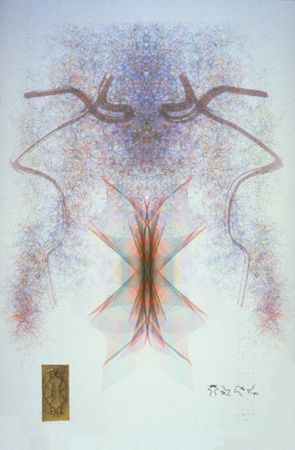
. The "illumination" for each work is realized with code
driven improvisations based on a single initiating stroke. This stroke,
generated by randomly cast control points, can be seen in the brush
strokes. Software procedures provide parameters to create reflecting or
mirror strokes on either or both axes or none at all.
The "script" headers and initials are derived
algorithmically from the
same set of relations; thus a "self-similarity" permeates the
whole. More recent routines allow for transformations of form from one
set of control points to another. The
same algorithm used for asymetrical works in the Pathway series drives
the recursive loops that generate the severely symmetrical "Ezekiel
series" illuminations.
Content
and Meaning . Parameter
controlled recursive loops are commonly used today in applications and
research in practically all disciplines. They provide an awesome means
for visualizing the evolution and transformation of form.
As we develop an iconology (interpretation) of these forms we
will see that they are the icons of those procedures which are shaping
our culture.
One could think of the works in all of these
series as diagrams or visual analogues to the coded procedures by which
they are made. The
essential character of the finished work is derived from the
"form-generating-procedure" or "algorithm" acting as
genotype . For this reason one could say that the finished work
is an epiphany, or manifestation, of the artist's code. Each work
celebrates its code, especially the recursive routines which shaped its
character. It is noteworthy that such procedures hold much in common
with processes associated with crystallization and genetics.
These epigenetic
works invite us to
savor both the beauty and the mystery of their coded procedures - not so
much for their stark logic as for the grace and poetry they yield.
They provide a window on unseen processes shaping mind and
matter. By doing so they become icons illuminating the mysterious nature
of Earth and Cosmos.
 |
 |
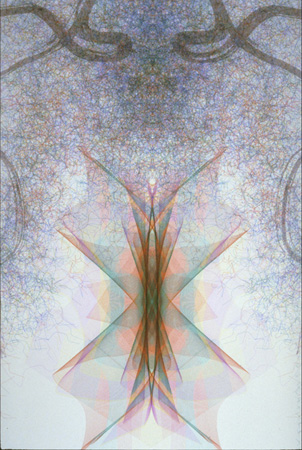 |
| Ezekiel version
shown at the Ukranian Museum in Chicago in 2015 was exhibited for
the first time at the 1993 Ars Electronica Sympoosium, |
German
Version
NOTIZEN ZUR EPIGENETISCHEN KUNST
DIE EZECHIEL SERIE
ROMAN VEROSTKO, April 1993Absichten. In meinen über dreißig Jahren als Künstler habe ich stets
versucht, wohlgefertigte Arbeiten mit ikonenhaften Qualitäten zu schaffen, die
in beziehungsreicher Weise auf versteckte Realität verweisen. Solange ich mich
erinnern kann, war ich immer überwältigt, wenn ich mir Zeit nahm, mir etwas
wirklich anzusehen und es als "seiend" zu betrachten und dann zu
überlegen,
ob das Gegenteil möglich sei — "nicht zu sein". "Wie wäre es",
fragte ich mich, "wenn es kein mich — keine Wolke — keine Erde gäbe?
Schon früh lernte ich, mir über das "großartige" Ereignis, daß
Dinge einfach "so wie sie sind" existieren, Gedanken zu machen.
Innerhalb alltäglicher Phänomene lernte ich, eine "versteckte" großartige
Welt voller Geheimnisse zu sehen. Mein Zugang zur Kunst erwuchs aus diesem
Staunen, indem er immer voll Ehrfurcht gegenüber Materialien der Erde war und
immer ein Gefühl von Staunen über die meisten Dinge beibehielt. Schließlich
begann dies auch Schalttafeln, Computersprachen und die Formen, die man mit
einfachen Algorithmen erforschen konnte, einzuschließen.
In diesem Essay können die Ausdrücke "Code", "Software"
und "Instruktionen" abwechselnd und miteinander austauschbar verwendet
werden. Generell beziehen wir uns auf kodierte Vorgänge und Algorithmen, die in
ein Instruktionsprogramm für einen Computer integriert werden können.
Während der letzten zehn Jahre lang habe ich Codes geschrieben und staunte
dabei über ihr Vermögen, Form mit einem Computer zu untersuchen. Codierte
elektronische Verfahren verschaffen Künstlern ein grundlegend neues und
wirksames Werkzeug zur Untersuchung einer wunderbaren Welt unsichtbarer Formen.
jene, die ihre Kunst mit codierten Verfahren integrieren, stehen an der Schwelle
einer neuen Grenze. Diese Grenze zu überschreiten, ist für einen Künstler
jedoch aufgrund zweier großer Hürden schwierig. Eine davon ist die Aufgabe,
Form-erzeugende Ideen in einen praktischen Arbeitscode zu übersetzen. Die
andere besteht in der Suche nach geeigneten Materialien und darin, Methoden zu
finden, die es möglich machen, greifbare, archivierende Qualitätsarbeit zu
erzielen.
Der Code als ein Form-Erzeuger ist aber nur die halbe Mühe. Um als "Kunst"
erfolgreich zu sein, muß die Form erfolgreich in etwas Greifbarem
hervorgebracht werden — etwas, das man sehen, angreifen, fühlen oder hören
kann. Vor einigen Jahren fragte ein Künstlerfreund von mir, als er bei einer
Ulme stand: "Was gibt diesem Baum so eine kraftvolle Präsenz?" Und er
antwortete, indem er anmerkte, das sei "seine Angreifbarkeit — die
Tatsache, daß man seine Oberfläche befühlen könne — sein Da Sein"! Da
die ästhetische Erfahrung die Sinne einschließt, kann man Kunst nicht von
ihrer materiellen Körperlichkeit trennen. In meiner momentanen Arbeit
beinhaltet die Form notwendigerweise das Papier, die Oberfläche, die
Beschaffenheit, die Farbe und die Art der Präsentation — also die gesamte
Erfahrung. Die Art und Qualität des Materials sind im Prozess sorgfältig
ausgewählt und verändert worden. Für mich sollte die fertige Arbeit eine Aura
besitzen, die den beiläufigen Betrachter veranlaßt, einen Moment lang
innezuhalten, und zu fühlen, daß die Arbeit, als ein menschliches Streben über
die materiellen Belange hinausgeht.
Studio Workers, Robotnics. Viele Leute, die mein Atelier besuchen, sind
erstaunt, wenn sie die technischen Drucker an zwei Computer Work Stations
angeschlossen sehen — einen für Forschung und Entwicklung — den anderen für
die Kreation von Kunst. Wenn ein Drucker arbeitet, stehen Besucher oft davor und
können ihre Augen nicht von dem Zeichenarm nehmen, der mit"scheinbarer
Intelligenz" präzise, überraschend und ohne zu zögern — buchstäblich
tausende Linien ausführend — zeichnet und die Farben ändert — einmal hier
dann dort. Diese Drucker strahlen eine unheimliche Präsenz aus! Sie sind
Mitglieder der Atelierfamilie geworden — da ist Brunelleschi, ein neun Jahre
alter 14—Stift—Drucker, der erste, den ich je verwendete — dann ein
weiterer namens Alberti, der alle Titelbilder für eine limitierte Auflage von
George Booles "Ursprung der Gesetze" (1989—90) ausführte. Unser
neuestes Mitglied dieser Familie ist Botticelli, der die jüngst entstandende
Ezechiel Serie ausgeführt hat.
Diese Arbeiter, Robotnics, führen unermüdlich Anweisungen aus, die ihnen über
den Computer eingespeist werden. Die Computer interpretieren den Code für sie.
Der Code ist im wesentlichen ein Reihe detailierter Instruktionen zur Ausführung
der Arbeit, d.h. welche Schritte zu unternehmen sind, um Farbentscheidungen zu
treffen, oder wie man Kontrollpunkte bestimmt. Dieser Vorgang Kunst zu erzeugen,
den ich "epigenetisch" genannt habe, wird bis zu einem gewissen Grad
von einigen heutzutage arbeitenden Künstlern angewandt.
Dragon Mountain I, 1989
(91 cm X 183 cm)
algorithmic drawing plotted with with ink pens and brush. Victoria & Albert Museum, London.
Epigenetische Kunst. Der Ausdruck Epigenesis, von der Biologie geliehen,
bezieht sich auf den Vorgang, bei dem eine ausgewachsene Pflanze oder ein Phänotypus
aus einem Samen oder Genotypus wächst. Analog "wächst" in meinem
Atelier das Kunstwerk (Phänotypus) aus der Software (Genotypus). Obwohl die
Software die grundlegende form-erzeugende" Information beinhaltet,
erfordert sie eine entsprechende "Umwelt" und "Nahrung",
wenn sie ein reifes Kunstwerk erzeugen soll. Dieser Prozeß des tatsächlichen
"Züchtens" der Arbeit in einer greifbaren Form ist, in Analogie,
"epigenetisch". Die reife Kunstform, verglichen mit dem Phänotypus,
kann nur mit greifbaren Materialien "gezogen" werden — wie Papier
und Tinten — und dann nur mit einer passenden Zusammenstellung von Computer
und Drucker, die, sozusagen, eine ernährende Umwelt ausmachen. Das
Zusamrnentreffen aller dieser Elemente ist erforderlich, um das Kunstwerk zu
züchten,
ein Prozeß analog zur biologischen Epigenese.
Ein persönliches Expertensystem. Die Software, mit einem Computer und
einem Drucker, bildet ein "persönliches Expertensystem". Das System
ist fähig, visuelle Formen zu erzeugen, die für mich als Künstler interessant
sind — Formen, deren Ursprünge der Künstler mit rekursiven Improvisationen
sowohl auf—, als auch verdecken kann. Die Auswahl der Materialien und die
Entwicklung der Software wuchsen Seite an Seite über einen Zeitraum von zehn
Jahren. Es wurde umfassend mit Papier, Tinten und Druckverfahren experimentiert.
Durch Versuch und Irrtum und scheinbar endlose Stunden des Experimentierens
entwickelte sich das System zu einem einzigartigen Set von Verfahren mit einer
eigenen Sprache.
Hodos. Die Software, unter laufender Überarbeitung, ist ein integriertes
Netzwerk von Verfahren namens Hodos nach dem griechischen Wort für
"Pfad" oder "Weg". Dieser Ausdruck beschreibt am besten die
sich entfaltenden Formen der ersten Serie von gedruckten Arbeiten, die als
"Wege" begriffen wurden. Nachdem ich einige Zeit in China unterrichtet
hatte, erkannte ich viele Analogien zwischen "hodos" und dem
orientalischen Konzept des "Dao" (Tao, der Weg). Mein Atelier, genannt
das "Weg Atelier" hat ein orientalisches Siegel, das von dem berühmten
Shufa-Meister Wang Dong Ling geschnitzt wurde. Wang, von den
Pinselstrichen des Computers beeindruckt, wählte den klassischen Ausdruck
"xiao jing zhai", "kleines Fußpfad-Atelier" als geeignet für
das Siegel. Viele Arbeiten, die in diesem Atelier ausgeführt werden, erhalten
dieses Siegel.
Formfamilien. Hodos ist fähig, eine Familie der Formen zu
erzeugen, die gleichzeitig verwandt und (doch) "einzig in ihrer Art"
sind. Das ist möglich, da das System wie ein chaotisches System arbeitet, das
dem "Schmetterlings-Effekt" unterliegt. Der "Schmetterlings"-Effekt
bezieht sich auf die Beobachtung, daß sogar winzigste Phänomene in einem
solchen System das Ganze beeinflussen — das Flattern eines
Schmetterlingsflügels,
so sagt man, hat einen Einfluß auf weltweite Wettermuster.
Die Hodos Abläufe sind Parameter, die von Vorgängen betrieben werden,
die fähig sind, visuelle Formen zu erzeugen, deren Ergebnisse ähnlichen
Effekten unterliegen. Mit "Parameter betrieben" meinen wir Abläufe,
die eine Funktion ausführen, die "nicht mehr als" und "nicht
weniger als" eine bestimmte Anzahl von Graden, Federstrichen oder Farben
umfaßt. Die geringste Änderung, sagen wir eine 0.005 Änderung im ersten Samen,
beeinflußt alle kontrollierenden Parameter und in Folge davon die endgültige
Form. Die "Auto" Modi, die in das System eingebaut sind, erlauben
"Hodos", seine Variablen zu ändern und das innerhalb von Parametern,
die ich wahlweise kontrollieren oder nicht kontrollieren kann. Die daraus
entstehenden Formen sind im Ausmaß der Variation der Programmparameter und in
der Art wie diese kontrolliert oder nicht kontrolliert werden miteinander
verwandt. Diese Dialektik zwischen "Kontrolle" und "Un-Kontrolle"
ist in den über 30 Jahren meiner Künstlerlaufbahn der Mittelpunkt meiner
Formbetrachtungen gewesen.
|
|
|
|
|
|
|
|
|