Early Monastic Period 1950 - 1959
Some of my work was lost in a 1963 fire that destroyed
much of the monastery.
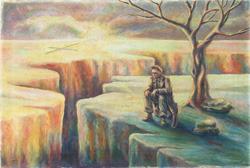 |
"Deciding", c.1951, oil on canvas, 19" by 28". This painting was made before entering my Novitiate year (1952-53). Follow the image links for a detail of the sitting figure. |
| MONASTERY COURTYARD PROJECT In the Summer of 1953 our Novice Class undertook to assist in the design and landscaping work for a Courtyard Garden. Located between the Monastery Chapel and the New Major Seminary the garden was dedicated to the Patron of Seminarians, St. Thomas Aquinas know as the Angelic Doctor. |
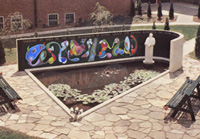 |
Angel Choirs 1953: A view of the statue, mural and pool in the late summer of 1953. René Gracida, an experienced architect and member of our novice class, created the design; Cecil Dietrich created the statue and I was given the opportunity to create this version of angels to celebrate the "Angelic Doctor". |
||
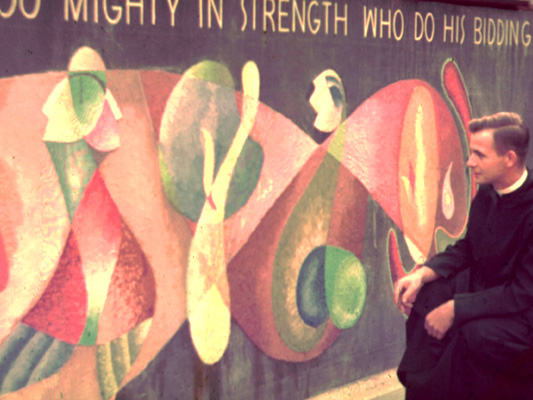 |
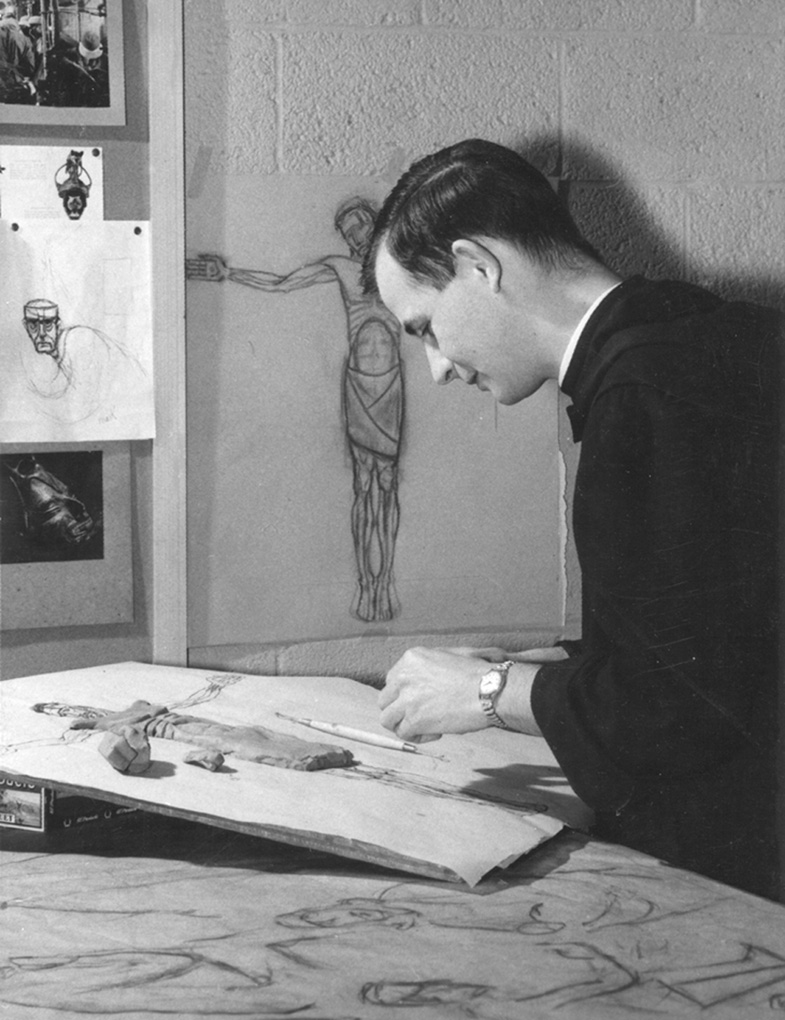
Angel Choirs, 1953. Detail shows me viewing the work while crouched on a temporary scaffold bridging the pool. This project represents my earliest efforts to create visual forms of the "unseen". This outdoor fresco did not fare well in the Pennsylvania winter. A second version with experimental media proved unstable also. These failures led me to a final version made with heavy gauge copper wire with brazed joints (see below). |
||
|
|
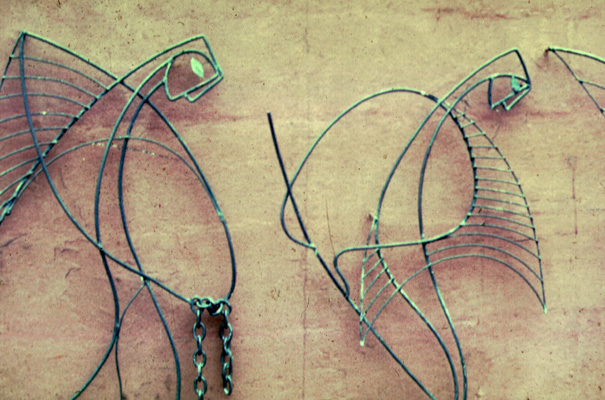
Angel Choirs,1955. Use of heavy gauge copper with brazed joints, allowed me to "draw" linear forms with three dimensional undulating lines. In this version the traditional nine choirs are symbolized and organized following the treatise of the Pseudo-Dionysius. Nine figures are organized in three orders with three in each order. Click on the images to see the groups and identities. Note on the influence of the "Celestial Hierarchy". These figures were dismounted some years later. Several have been preserved and others may be lost. |
||
|
|
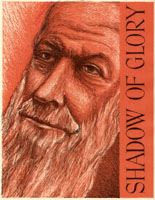
Drawing of Boniface Wimmer, founder of St. Vincent Archabbey, 11" by 8.5", 1955. Black ink line drawing with overlay of scratch lines on red. The program cover for a 1955 play, Shadow of Glory, that chronicled high-lights of the life of Boniface Wimmer. Technique: Line drawing in 2 layers. Layer 1 is a black & white pen and ink drawing. The text "Shadow of Glory" is also hand drawn in black. The red-orange overlay is a "scratch" drawing. A sheet of Mylar coated with a solid color was scratched to reveal white lines of the paper field underneath. This was a line color separation technique for creating two zinc cut line plates, one for the black line work and one for the negative white lines in the color field.
|
||
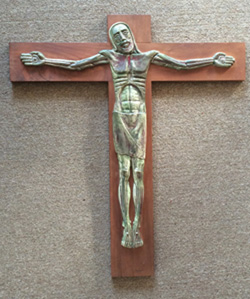 |
CRUCIFIX, Glazed ceramic on stained oak, 1958. Glazed ceramic tile on stained oak, 24" by 21". Edition of about 24 included both red and green glazes. Collection: Ryan Emmett, Pittsburgh
|
||
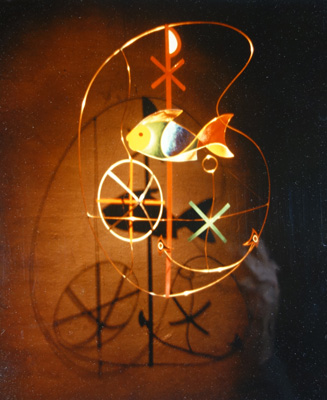 |
Early Christian Symbols, Enameled Copper, ca.4 ft w by 6 ft h. This Assemblage of early Christian symbols suspended in basement passage way to the St Vincent Basilica crypt. These four symbols with the lighting and cast shadow were intended as a meditative entrance space for the crypt. The architectural space and lighting were conceived and mastered by René Henry Gracida.
|
||
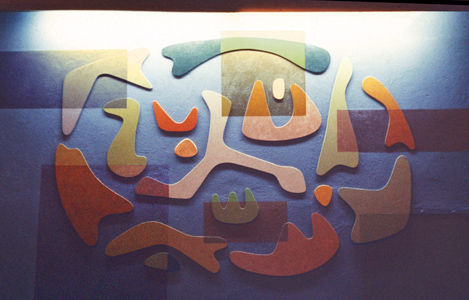 |
Mural, Untitled,
ca. 1956. Collage, clerics* recreation room. Shapes cut
out from Masonite were painted and mounted on
a masonry wall with fluorescent lighting. This project shows
the influence of Jean Arp whose work I greatly admired. During these
monastic years my various projects adapted approaches exhibited by early 20th Century artists
whose work appealed to me..
*Clerics. This term referred to monks with the title Frater (Brother) who were following theological studies for the Priesthood. After ordination they were referred to as "priests" and held a higher rank than the "clerics". |
||
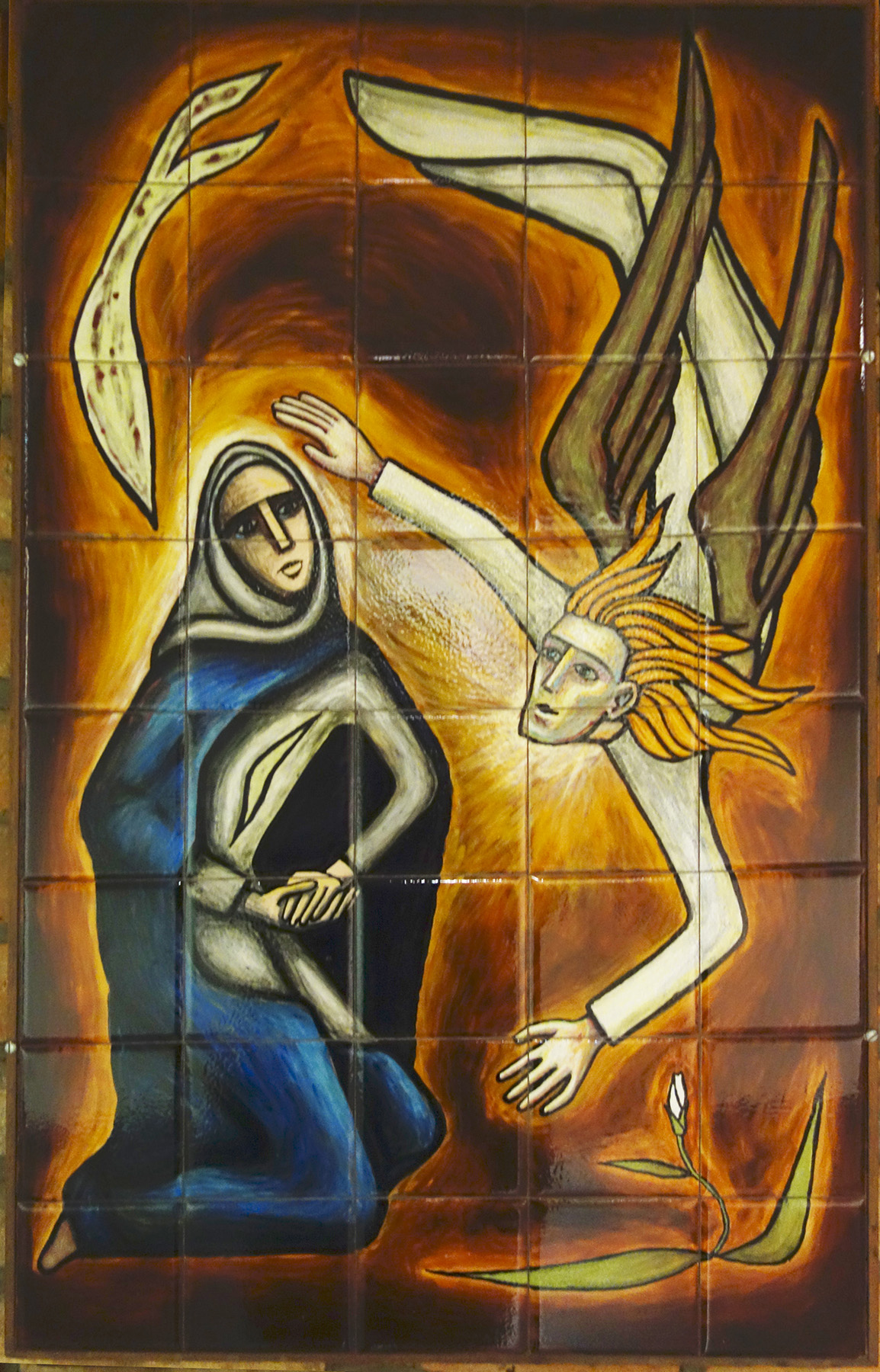 |
Annunciation, ceramic tile, 4 ft by 2.5 ft. This work was created with the materials and technologies that were the same as the Library mural. Two others, with the same size and technology were created at that time: the a glorious resurrection and my version of Benedict raising the dead child. | ||
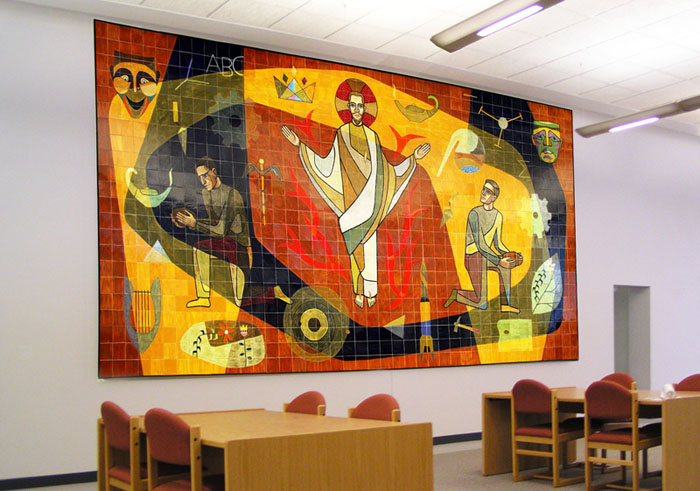 |
Ceramic Mural, St. Vincent Library. This ceramic tile mural, measures 11 feet by 22 feet, I had designed, glazed and fired all the tile at St Vincent before I went to New York for advanced studies. Each piece was coded for assembly. The preliminary work on the Library project was begun in the 1958-59 academic year and completed in the Spring of 1960. The tile were stored for installation before I left for advanced study in New York. The mural was installed in 1961 and the dedication date has been quoted in another source as 1962. |